TAX · INCOME & PAY · 2026/27
UK Tax Codes and National Insurance Explained
A visual guide to two separate parts of your payslip—and how each can change the amount reaching your bank account.
Your tax code helps your employer calculate PAYE Income Tax. National Insurance is calculated separately using your earnings, pay period and National Insurance category.
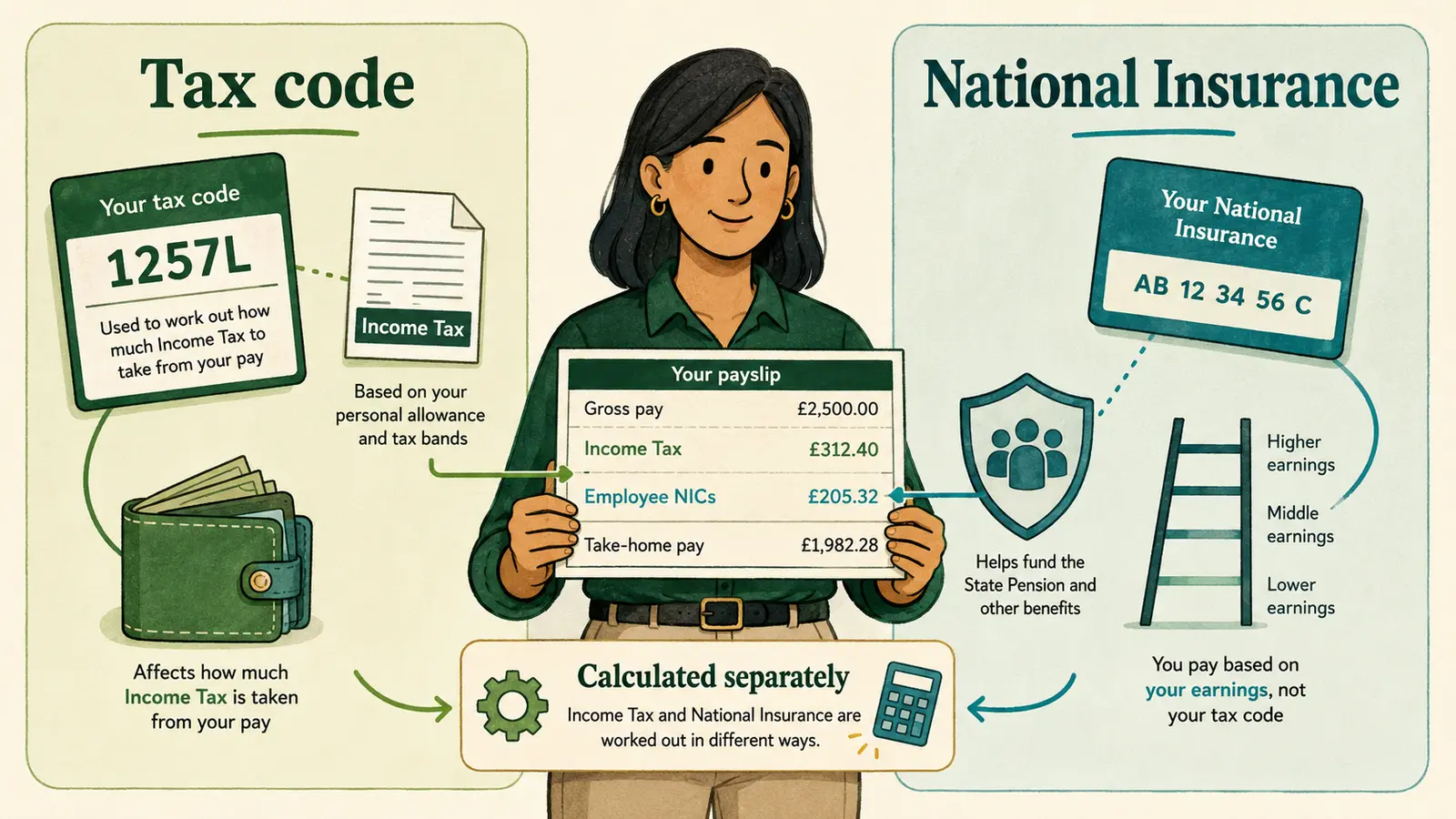
Tax codes and National Insurance: what is the difference?
| Payslip item | What it controls | Usually determined by |
|---|---|---|
| Tax code | How PAYE Income Tax is calculated | HMRC |
| National Insurance category | Which employee and employer NI rules apply | Your circumstances and payroll information |
| NI thresholds | When employee NI begins and when its rate changes | UK government |
| Pay frequency | How thresholds are applied to each payroll period | Your employer’s payroll |
A change to your tax code can affect Income Tax without changing National Insurance. Similarly, crossing an NI threshold can change your National Insurance deduction without changing your tax code.
What does a UK tax code mean?
Most tax codes contain numbers and letters. The numbers normally indicate how much tax-free income can be applied to that employment or pension. HMRC generally adds a zero to the number to show the approximate tax-free amount.
Example: 1257 × 10 = £12,570. The letter explains your tax position or an adjustment being applied.
The standard code 1257L is currently used for many people with one main job or pension. It normally represents the standard £12,570 Personal Allowance.
Common UK tax codes explained
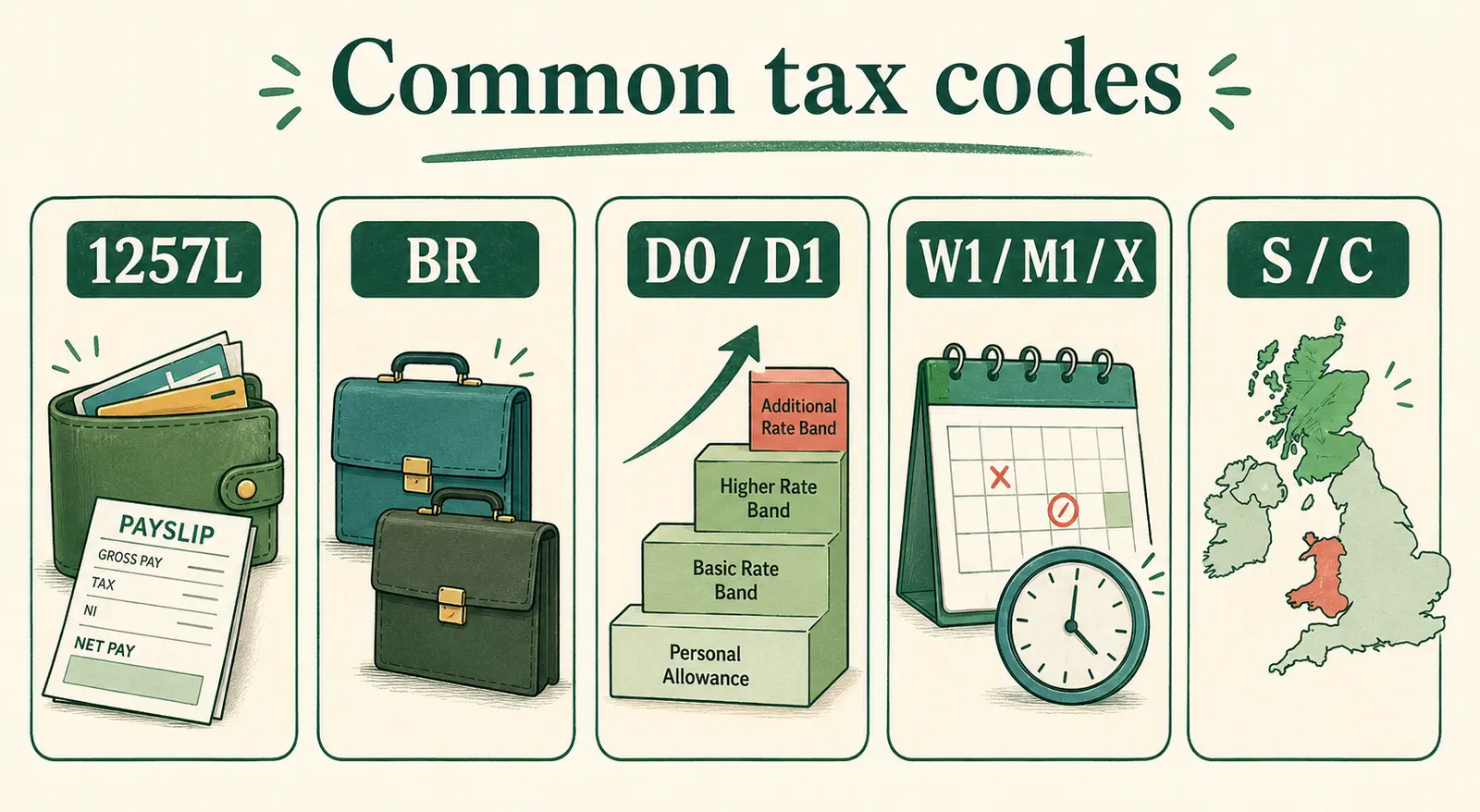
1257L
This is the standard tax code for many people with one main job or pension. It normally applies the standard £12,570 Personal Allowance. Read our detailed guide to tax code 1257L.
BR
BR normally means that all income from that particular job or pension is taxed at the basic rate. It is often used for a second job because a person’s Personal Allowance may already be applied to their main employment.
D0 and D1
For taxpayers outside Scotland, D0 normally taxes all income from that job at the higher rate, while D1 normally applies the additional rate. These codes may appear where HMRC expects a person’s total income to fall into a higher tax band.
0T, NT and K codes
0T normally means no Personal Allowance is available for that employment. NT means no Income Tax is being deducted from that particular income. A K code can be used when deductions or untaxed income in the calculation exceed the available Personal Allowance.
S and C prefixes
An S prefix means Scottish Income Tax rates apply. A C prefix means Welsh Income Tax rates apply. The prefix changes which regional rates are used; it does not create another Personal Allowance.
What are emergency tax codes?
A tax code containing W1, M1, X or NONCUM is normally an emergency or non-cumulative code.
Payroll then calculates tax using the current week or month without fully considering earlier pay and tax in the same tax year. This can sometimes result in too much or too little tax being deducted.
Emergency codes often appear when someone starts a job and complete payroll information is unavailable. Check that your employer has received your P45 or starter-checklist information, and review your details with HMRC if the code does not update.
National Insurance thresholds for 2026/27
For most employees, Class 1 National Insurance is calculated separately in each pay period.
| Threshold | Annual | Monthly | Weekly | What it means |
|---|---|---|---|---|
| Lower Earnings Limit | £6,708 | £559 | £129 | Employee NI is not paid, but earnings at or above this level may protect benefit entitlement |
| Primary Threshold | £12,570 | £1,048 | £242 | Employee NI normally begins above this level |
| Upper Earnings Limit | £50,270 | £4,189 | £967 | A lower employee NI rate normally applies above this level |
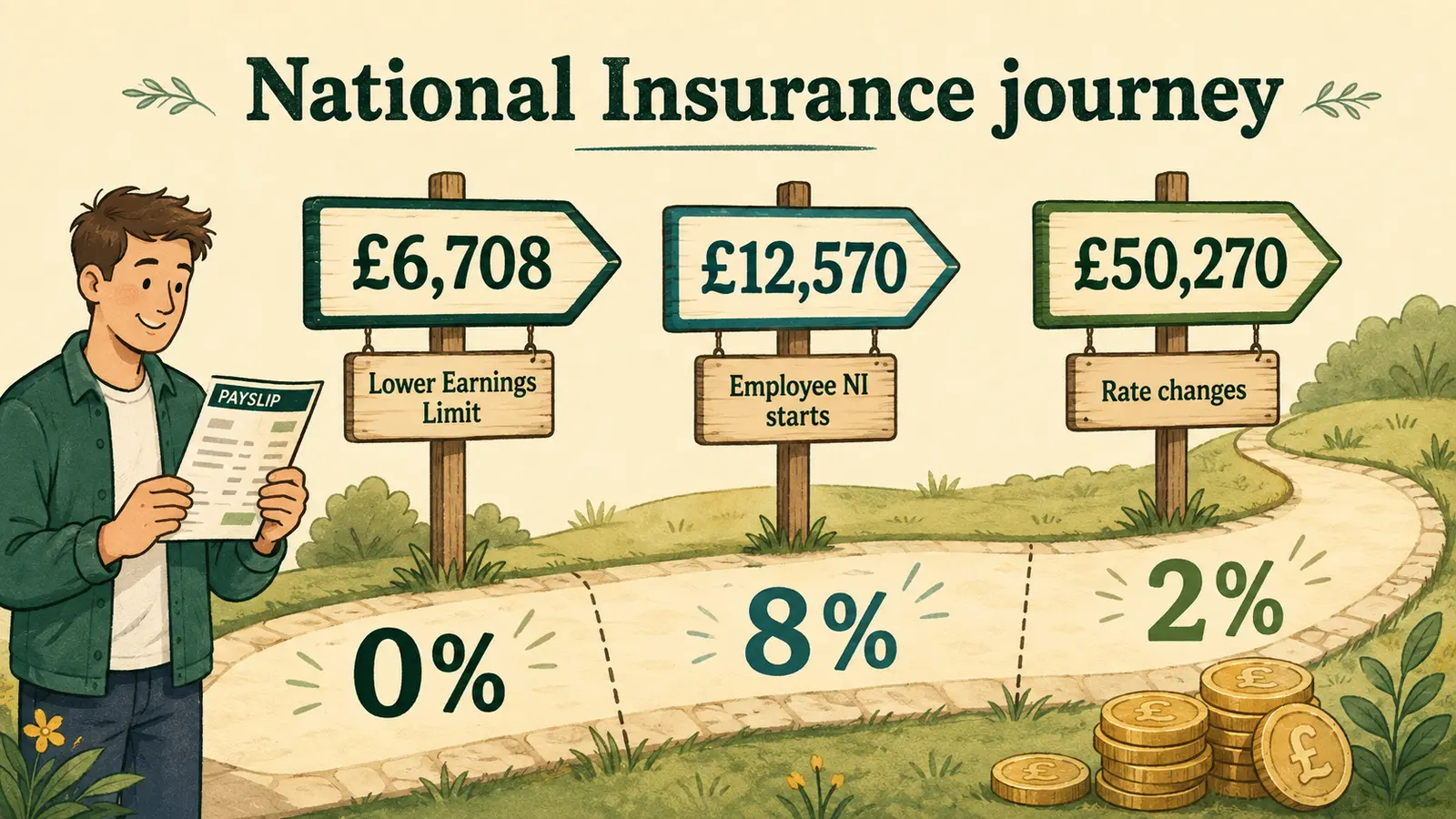
Employee National Insurance rates for 2026/27
For a standard employee using NI category A, the main rates are:
- 0% on earnings up to the Primary Threshold
- 8% on earnings above the Primary Threshold and up to the Upper Earnings Limit
- 2% on earnings above the Upper Earnings Limit
This does not mean your entire salary is charged at 8% or 2%. Each rate applies only to the relevant part of your earnings. Different rates can apply to employees with another National Insurance category.
What do National Insurance category letters mean?
Your NI category letter appears on your payslip and tells payroll which National Insurance rules to use.
| Category | Typical use |
|---|---|
| A | Most employees |
| B | Certain married women and widows with a valid reduced-rate election |
| C | Employees over State Pension age |
| H | Apprentices under 25 |
| J | Employees who can defer NI because they have another job |
| M | Employees under 21 |
| V | Certain qualifying veterans |
| Z | Employees under 21 who can defer NI because they have another job |
| X | Employees who do not pay National Insurance in that payroll |
The correct category depends on the employee’s circumstances. It is not the same as a PAYE tax code.
Does employer National Insurance reduce take-home pay?
Employer National Insurance is a separate cost paid by the employer. It is not normally deducted from the employee’s stated gross salary.
For 2026/27, the standard employer rate is generally 15% on applicable earnings above the employer Secondary Threshold of £5,000 a year, subject to category-specific rules and available reliefs.
Example: tax and National Insurance on a £30,000 salary
Consider an employee in England with tax code 1257L, NI category A and no pension, student loan or other adjustment:
| Calculation | Illustrative amount |
|---|---|
| Gross salary | £30,000 |
| Personal Allowance | £12,570 |
| Income subject to basic-rate Income Tax | £17,430 |
| Illustrative Income Tax | £3,486 |
| Earnings subject to the main employee NI rate | £17,430 |
| Illustrative employee National Insurance | £1,394.40 |
The estimated amount remaining after these two deductions would be approximately £25,119.60 a year, before any pension, student-loan or other payroll deductions. Actual payroll results can differ because tax and NI are calculated through individual pay periods and may involve rounding or other adjustments.
What should you check on your payslip?
- Gross pay
- Tax code
- Income Tax deducted
- National Insurance category
- Employee National Insurance deducted
- Pension, student-loan and other deductions
If your tax code appears wrong, check the information held by HMRC. If the code is correct but the payroll calculation appears wrong, speak to your employer’s payroll team.
Frequently asked questions
Is a tax code the same as a National Insurance number?
No. A tax code helps payroll calculate Income Tax. Your National Insurance number identifies your National Insurance and tax record.
Does tax code 1257L include National Insurance?
No. National Insurance is calculated separately and is not controlled by tax code 1257L.
Why do I have BR on my second job?
BR may be used because your Personal Allowance is already applied to your main job. It is not automatically an incorrect code.
Do I receive a separate Personal Allowance for every job?
No. You receive one Personal Allowance across your income, although HMRC may divide it between different employments or pensions.
Why has my National Insurance deduction changed?
It may change because your earnings, pay frequency, NI category or the applicable government thresholds have changed.
Where can I check my tax code?
You can check it on your payslip, P45, P60, HMRC tax-code notice or through your HMRC online account.
The bottom line
Tax codes and National Insurance both affect take-home pay, but they are calculated independently. Your tax code determines how PAYE Income Tax is applied. Your National Insurance deduction depends on earnings, pay period and NI category.
Checking both items on your payslip is one of the simplest ways to identify an unexpected payroll deduction.
Important information
MoneyMeasure provides general information and illustrative calculations, not personalised tax, financial or payroll advice. Confirm your official position using HMRC’s tax-code guidance and the official 2026/27 rates and thresholds.
Read our methodology, disclaimer and privacy policy.
Last reviewed: 15 August 2026.